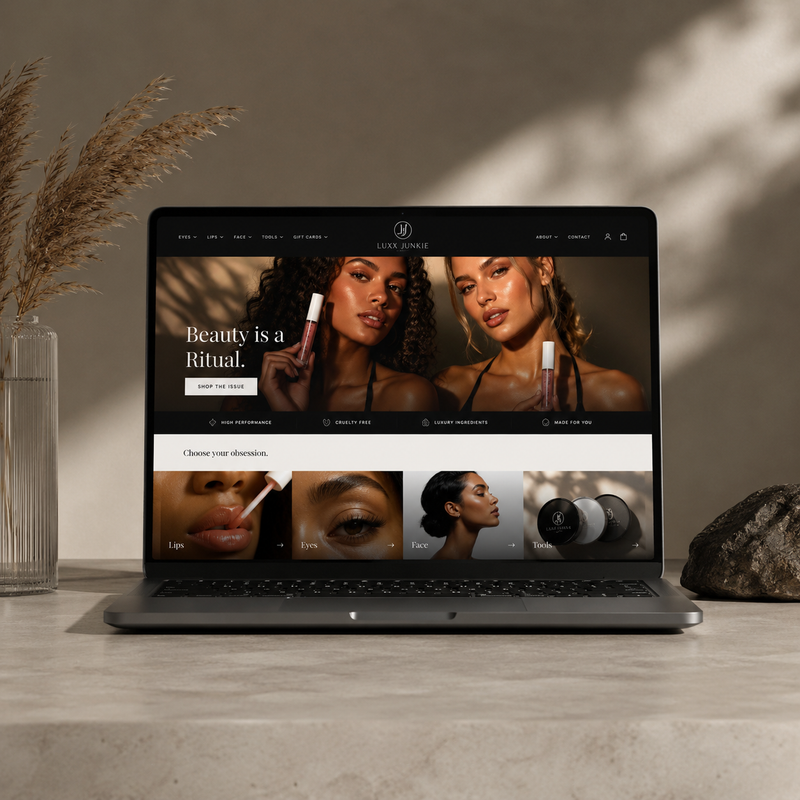
5 Things I'd Fix on Your Website First

I have been building online businesses for over 12 years. Photography. Digital products. Memberships. Ecommerce. I have run my own Meta ads, written my own email sequences, designed my own Shopify stores, and served over 15,000 customers.
That track record means I have made every mistake there is to make. And more importantly, I know exactly which ones are costing you the most money right now.
If I looked at your store today, these are the five things I would fix before touching anything else.
1. Your above-the-fold section is not doing its job
The first thing someone sees when they land on your site decides whether they stay or leave. Most stores waste that moment.
Above the fold should answer one question instantly: what is this and why should I care? Not your full brand story. Not five CTAs. Not a carousel that most people never interact with.
One clear headline that speaks to a specific person. One image that shows them what this brand feels like. One action they can take.
If your homepage hero makes someone think at all about what you sell or who you are, it is not working.
2. You have no trust architecture
Trust is built through accumulation of small signals. Reviews. Social proof. Real images of real people using the product. Specifics instead of generalities. A refund policy that is easy to find. An about page that sounds like a human being wrote it.
Most stores have some of these. But they are scattered randomly across the site instead of being placed deliberately where trust needs to be built.
The highest-leverage trust placement on any ecommerce store: directly below the add-to-cart button on the product page. That is the moment of maximum hesitation. A single line, a review snippet, or a trust badge placed there will increase conversion more than almost anything else you could do.
3. Your email capture is invisible or nonexistent
Email is the highest-ROI marketing channel in ecommerce. Not ads. Not social. Email. The average ecommerce store generates $40 in revenue for every $1 spent on email marketing.
And most stores either have no email capture at all, or they have a generic popup that says "sign up for updates" with no reason to say yes.
Your email capture needs an actual offer. Not a discount if you are not a discount brand. But something: early access, a guide, a checklist, a quiz result, a freebie that is genuinely useful to your specific customer.
Get people on your list. Then email them. This is the single highest-return change most store owners can make.
4. Your navigation is hiding your best products
Most Shopify navigation menus are built in the order things were created, not in the order a customer should encounter them. The result is that your most popular products, your bestsellers, the things most likely to convert a first-time visitor, are buried two clicks deep.
Your navigation should be built around your customer's decision-making process. What does someone need to know first? What do they compare? What do they buy most?
If you have a product that converts at a significantly higher rate than the rest, it should be easier to get to, not hidden behind a collection page.
5. You are not using your data
Most Shopify store owners look at their dashboard occasionally and feel vaguely good or bad about the numbers. But the data available to you is significantly more useful than that.
Where are people dropping off in your checkout? Which products have the highest view-to-purchase ratio? Which traffic source converts best? What is your cart abandonment rate and what is triggering it?
These are all knowable. And each one points to a specific lever you can pull.
If you are not reading your analytics with a specific question in mind, you are flying blind while your competitors are navigating.
What this all adds up to
These are not design opinions. They are the patterns I see over and over in stores that are underperforming relative to the quality of their product.
The good news is that most of them are fixable without a full rebuild. The first step is knowing exactly which ones apply to your store.
A Brand Review gives you a clear, prioritized read on exactly that.
Your brand deserves a real audit.
A Brand Review goes through your entire online presence and gives you a prioritized plan to fix what matters most. Most clients walk away seeing their business completely differently.